
Issue #2 — 6 Opportunity Signals: Agent observability, healthcare admin software, prediction market infrastructure, AI financial rails, industrial heat, and CEE payments
Six market gaps where capital is already moving: AI agent observability (only 15% of deployments instrumented), healthcare admin SaaS for independent practices ($740B admin spend barely touched by software), prediction market data infrastructure (Kalshi now valued at $22B), AI financial rails for autonomous agents (a16z-backed Catena Labs), industrial heat decarbonization software for emerging markets, and CEE regional payment fragmentation.

研究速览
The macro read for this week: capital is moving closer to the budget owner and further from the model provider. The biggest checks in recent funding windows went to companies that own workflows, sit inside compliance requirements, or process money flows that enterprises can't afford to break. General AI enthusiasm is not gone, but investor tolerance for weak differentiation has essentially reached zero. What follows are six gaps where demand is visible, supply is structurally thin, and the 2026 context gives an entrant a real reason to exist now rather than in two years.
Tech
1. AI agent observability: the monitoring gap that only 15% of deployments have closed
The premise of AI agents in production — autonomous multi-step execution, tool calls, model reasoning chains — breaks every assumption traditional monitoring was built on. A service either returns 200 or throws an error. An agent can return a confident, well-formed, completely wrong answer after making three unnecessary tool calls. Binary pass/fail health checks are blind to all of it.1
The gap is quantified: only about 15% of GenAI deployments instrument observability at all, per a Gartner figure cited in a May 2026 industry guide. The LLM observability market itself stands at roughly $2.69 billion in 2026, growing at approximately 36% CAGR — yet the vast majority of AI-native software is still running blind.1 This is the same dynamic that made APM (application performance monitoring) a large business after web applications scaled beyond what log files could explain.
The VC signal supports this reading. Coralogix raised a $200 million Series F in June 2026 — just 11 months after its Series E — co-led by Advent, CPP Investments, and Greenfield, valuing the company at $1.6 billion. It now has more than 5,000 customers and grew revenue over 60% in the past year.2 Coralogix pitched this round explicitly as "the observability layer for AI agents" — a meaningful framing shift from its earlier general-purpose positioning.
正在加载内容卡片…
Competitive landscape: Langfuse (acquired by ClickHouse in January 2026), Braintrust ($80M Series B in February), Helicone, Arize Phoenix, and LangSmith each address parts of the stack. Most are positioned either as developer tools (fast to adopt, hard to sell to enterprises) or as general APM providers adding GenAI modules (hard to adopt, already in enterprise stacks). The OpenTelemetry GenAI semantic convention standard is still in Development status as of v1.41 — nearly all
gen_ai.* attributes can change without a major version bump — which means multi-tenant, enterprise-grade, compliance-ready observability that stays current with the spec is genuinely unsolved.Feasibility: The buildable wedge here is a compliance-first agent observability layer targeting regulated industries (finance, healthcare, legal) where enterprises already have to document model decisions for audit purposes. The tech stack is approachable — OTel-native instrumentation, structured span ingestion, anomaly detection on reasoning traces. The moat is workflow integration and audit trail format compatibility with existing GRC tools.
Primary risk: Consolidation moves fast. If Datadog, Dynatrace, or a major cloud provider releases a credible agent observability product before a startup establishes enterprise contracts, the window closes quickly.
2. Prediction market data and trading infrastructure
Kalshi raised $1 billion in May 2026 at a $22 billion valuation. Polymarket is in talks to raise $400 million at a $15 billion post-money. Combined monthly global trading volume on the two platforms crossed $24 billion, up from under $5 billion a year earlier.3 The $44 billion in global prediction market volume in 2025 and $29.8 billion in April 2026 alone signal a market that's become real enough to attract institutional adoption.4
The structural gap isn't in building another prediction market. It's in building the infrastructure layer around the markets that neither Polymarket nor Kalshi provides. Specifically: cross-asset strategy execution, AI-assisted signal processing, and portfolio-level risk management that spans prediction markets, crypto perpetuals, equities, and commodities in a single account.5
A sophisticated trader watching Kalshi price a 70% probability on a Fed rate cut needs to execute a correlated BTC long position on a separate platform — manually, across two interfaces, with no unified risk view. That friction is the whitespace. Platforms like Hyperliquid are already adding prediction markets, and Polymarket is adding perpetuals — evidence that users are demanding convergence. No one has built the cross-asset infrastructure layer with AI-assisted signal aggregation.
Competitive landscape: Polymarket and Kalshi dominate volume but lack cross-asset execution. Traditional trading infrastructure (IBKR, CME) serves institutional demand but hasn't integrated event markets. The UX and compliance gap for retail-to-institutional cross-category trading is currently unserved.
Feasibility: A backtesting platform specifically for prediction markets is already finding product-market fit at small scale — a solo founder building one in this niche recently hit €10K MRR in a month without external marketing, citing the absence of structured historical market data tools as the core gap. The larger infrastructure play requires regulatory navigation and deep liquidity relationships, but the data tooling layer is buildable quickly.
正在加载内容卡片…
Primary risk: Both Polymarket and Kalshi are actively expanding their own feature sets. If either builds native cross-asset capability with good UX, the infrastructure play loses its wedge.
B2B
3. Healthcare admin software for independent practices: converting labor spend into software
US healthcare spends approximately $740 billion annually on administrative work, of which only $63 billion has been converted to software.6 That ratio — less than 9 cents of every administrative dollar currently runs through software — is the structural opportunity. The market isn't short on innovation in clinical AI or consumer health apps. It's short on boring, narrow, vertical SaaS that removes a specific paperwork-heavy workflow from a clinic and gets paid for it.
The most validated unmet needs right now:
- Prior authorization automation: The average physician completes 39 prior-auth requests per week, consuming 13 hours of staff time. 40% of practices hire dedicated staff just to manage this.6 Large healthcare systems have partial tools; independent practices and specialty clinics have nothing designed for them.
- Specialty medical coding and denial appeals: 10–15% of claims are rejected on first submission. Coding tools serve hospitals, not the 50,000+ independent specialty practices filing the same codes daily against the same payer rules.
- Voice AI front desk for small clinics: The healthcare front-office labor market is worth $80–100 billion annually. Enterprise voice AI vendors (Nuance, Suki) have 18-month sales cycles targeting large health systems. Independent clinics — dentists, dermatologists, orthopedics — are effectively untouched.
The VC validation is concrete: Lassie, which automates insurance portal workflows for small healthcare practices, raised a $35 million Series A led by a16z in June 2026 at $47 million total funding. It now operates in 700+ practices across 49 states, delivers 250,000+ hours of annual labor equivalent, and is explicitly positioned as autonomous execution software — not an AI assistant that suggests actions, but one that completes them.2
Competitive landscape: The major RCM incumbents (Waystar, Change Healthcare, Kareo) serve hospitals and large groups. The independent practice segment — below 10 physicians — is underserved by all of them. The moat here isn't the model; it's payer-specific workflow training, EHR integration, and HIPAA-compliant data handling, all of which generic AI tools cannot replicate cheaply.
Feasibility: High. The target buyer already pays for human labor to do this work. The sale is a replacement, not a new budget line. Two-week integration cycles and usage-based pricing (per claim processed, per auth filed) work well with the cash-flow patterns of small practices.
Primary risk: EHR systems (Epic, Athena, eClinicalWorks) are building native automation modules. If Epic launches a general prior-auth tool with bundled pricing, independent software loses its distribution advantage — though Epic's historical record of serving small practices is poor enough that this threat is medium-term at best.
4. AI financial rails for autonomous agents: the compliance infrastructure gap
Every AI agent that handles money — paying invoices, rebalancing portfolios, routing payroll, executing trades — currently runs on financial infrastructure designed for humans. Banking APIs require human authentication steps. Card networks flag automated card use as fraud. ACH rails don't support programmable logic. The infrastructure mismatch creates a real problem: AI agents handling funds either break compliance or operate illegally.
Catena Labs raised a $30 million Series A co-led by a16z crypto and Acrew Capital (with Breyer Capital participating) to build what it calls "regulated financial infrastructure purpose-built for autonomous software" — programmable accounts where AI agents can act on behalf of humans within defined compliance rails.7 The company is applying for OCC banking licenses and building B2B compliance infrastructure for agent-to-agent transactions.
This is a real category gap. When agentic AI moves from demo use cases to real business process automation — accounts payable, treasury management, multi-party contract settlement — the financial infrastructure layer needs to exist. It currently doesn't. The analogy is Stripe in 2010: payments infrastructure was technically possible before Stripe, but developer-hostile and compliance-heavy enough that most products didn't try.
Competitive landscape: Stripe, Mercury, and Brex have programmable APIs but were built for human-initiated transactions. None have compliance structures for AI agents acting without human approval at transaction time. Legacy banking middleware providers (FIS, Fiserv) lack the developer orientation to build this. The Catena raise signals that well-capitalized competitors will enter within 12–18 months.
Feasibility: High technical complexity, but validated investor appetite and a clear category. The wedge for a new entrant would be a specific vertical — e.g., procurement automation for mid-market companies, or treasury operations for multi-entity family offices — rather than attempting general-purpose AI banking infrastructure.
Primary risk: Regulatory risk is significant. Banking and money transmission licenses take 12–24 months. Jurisdictional fragmentation (especially US vs. EU) creates compliance overhead that could swallow early capital.
Consumer
5. Industrial heat decarbonization: the $900B market that's structurally underserved on software and services
Industrial heat — the thermal energy used in food processing, textiles, pharmaceuticals, chemicals, cement, and steel — accounts for 14% of global CO₂ emissions. That's equivalent to all road transport, aviation, and shipping combined.8 The global industrial heat market is valued at approximately $900 billion today, on track to cross $1 trillion by 2030.
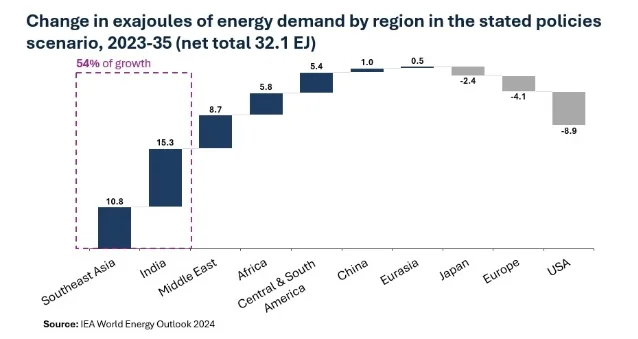
The opportunity signal isn't just the size. It's the policy-demand convergence happening now in emerging markets. India plans 500 GW of renewable energy by 2030, up from 175 GW today. Singapore's carbon tax is set to increase tenfold by 2030. The EU's carbon border adjustment mechanism creates export pressure on Southeast Asian manufacturers. India's carbon trading scheme compliance kicks in this year.8 The industrial heat market in Southeast Asia and India alone is projected to grow from $130 billion to as much as $400 billion by 2050.
Terra AI raised a $20 million Series A in June 2026 from Khosla Ventures and BHP Ventures to apply AI to geological exploration — compressing a 17-year average discovery-to-production cycle for mineral and energy resources.2 The adjacent logic applies to industrial heat: the software layer for decarbonization project scoping, heat pump system design, electrification retrofit planning, and carbon credit quantification for industrial facilities is essentially unbuilt. The incumbents are engineering consultancies charging day rates, not software companies charging per project or per ton of CO₂ tracked.
Competitive landscape: McKinsey, BCG, and niche engineering firms (Hatch, WSP) serve the top 200 industrial operators. The mid-market — food processors, textile manufacturers, pharmaceutical contract manufacturers — has no software designed for them. Broad climate-tech platforms (Watershed, Persefoni) focus on reporting, not project execution.
Feasibility: Medium difficulty. The technical domain knowledge requirement is high, and the sales cycle into industrial buyers is long. But the regulatory urgency is compressing timelines: a manufacturer facing EU CBAM penalties in 18 months can't wait for a 2-year consulting engagement. Vertical-specific tools (e.g., heat pump design and ROI calculator for food & beverage processors) offer a faster path to first revenue than general-purpose decarbonization platforms.
Primary risk: Industrial buyers are conservative and slow. A startup that requires significant consulting services alongside its software may not scale efficiently. Building with an engineering firm as co-founder or first channel partner substantially de-risks go-to-market.
6. CEE and emerging corridor payments: fragmented rails as durable fintech infrastructure
Central and Eastern Europe is eight distinct card networks, six dominant local payment methods, four currencies, and three regulatory frameworks across a trade bloc that transacts intensively across borders. The result is that a merchant selling in Poland, Romania, Hungary, and the Czech Republic today needs four separate payment integrations — or pays a global PSP a premium for fragmented, incomplete local method coverage.
Paypercut raised a €5 million seed round in June 2026 co-led by Concentric, Passion Capital, and Araya Ventures, growing to €7 million total funding. The Sofia-based company offers a single API for card payments, local methods, BNPL, payment links, QR codes, billing, payouts, and settlements across eight CEE markets — and is applying for an Irish EMI license to extend reach further. It's also building stablecoin-based transfer rails for high-friction non-euro corridors within the region.2
The broader pattern here has structural legs. Regional payment fragmentation is one of the most reliably fundable fintech pain points because it can be addressed through infrastructure rather than brand marketing. Forage, which modernizes SNAP and EBT payment rails used by roughly 40 million Americans, closed a $40 million Series B in June 2026 from Mouro Capital, PayPal Ventures, Nyca Partners and others — at a $225 million valuation — on the same thesis: regulated, compliance-heavy payment rails that larger PSPs don't want to build because the integration cost seems higher than the revenue.2 Until someone builds them, they're free money.
Competitive landscape: Stripe supports basic CEE markets but covers perhaps 60–70% of local payment methods with known gaps in Romania, Bulgaria, and the Baltic states. Adyen and Checkout.com have similar coverage gaps and are priced for mid-market enterprises, not SMBs. The underserved segment is the €1M–€50M revenue digital merchant selling across multiple CEE markets.
Feasibility: High. Regional payment infrastructure businesses have clear unit economics (take rate on GMV), manageable compliance overhead compared to full banking licenses, and sticky customer relationships once integrated. The regulatory work is real but well-trodden — EMI licenses in Ireland and Lithuania are established paths.
Primary risk: Stripe or Adyen expanding CEE coverage through acquisitions or dedicated regional product investment would immediately pressure pricing. The defensible position is depth of local method coverage and the stablecoin settlement layer for non-euro corridors — two things global PSPs won't prioritize for a region their revenue models treat as secondary.
Quick scan
| Signal | Sector | Validation | Primary risk | Time horizon |
|---|---|---|---|---|
| AI agent observability | Tech | Coralogix $200M Series F; 15% instrumentation rate | Cloud vendor consolidation | 12–18 months |
| Prediction market infrastructure | Tech | Kalshi $22B val; $44B annual volume | Platform self-builds | 18–24 months |
| Healthcare admin SaaS (practices) | B2B | Lassie $35M a16z; $740B admin spend | EHR native modules | 12–24 months |
| AI financial rails for agents | Tech | Catena Labs $30M a16z crypto | Regulatory timeline | 24–36 months |
| Industrial heat decarbonization software | B2B | RMI $900B market; policy convergence | Long sales cycles | 18–36 months |
| CEE + emerging corridor payments | B2B Fintech | Paypercut seed; Forage $40M Series B | Stripe/Adyen expansion | 12–18 months |
参考来源
- 1AI Agent Observability 2026: Tracing & Monitoring Stack
- 2Venture Capital & Startup Funding Roundup, June 3, 2026
- 3After Polymarket and Kalshi, Will There Be Another Dark Horse?
- 4Prediction & Event Market Regulation 2026
- 5Beyond Prediction Markets: Why Traders Need More Than Polymarket or Kalshi in 2026
- 613 Healthcare Startup Ideas for 2026 (Clinics Will Pay)
- 7Investing in Catena Part II – a16z crypto
- 8The Heat Is On: Decarbonizing Industrial Heat in India and Southeast Asia
围绕这条内容继续补充观点或上下文。