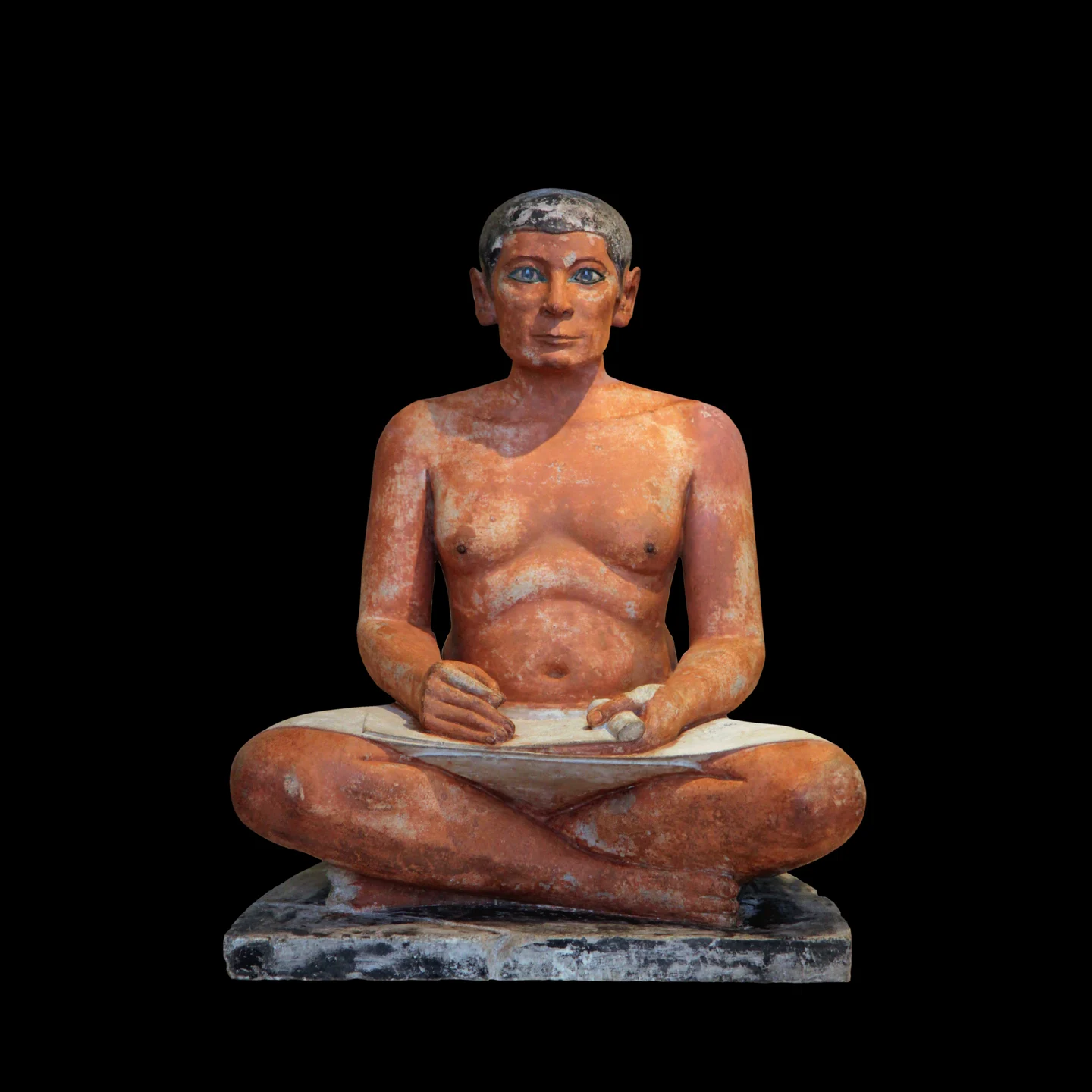
The Man Who Has Been Waiting 4,500 Years
In Room 635 of the Louvre's Sully Wing, a limestone scribe has been sitting cross-legged since 1854 — reed pen gone, papyrus blank, identity unknown. This article traces the full story of Louvre E 3023 (c. 2675–2545 BCE): the scribal culture of pyramid-age Memphis, the engineering miracle of its inlaid rock-crystal eyes, the 170-year identity debate between two scholarly candidates, Auguste Mariette's chaotic 1850 excavation at Saqqara, and how the statue went from a desert shaft to the world's most visited museum.
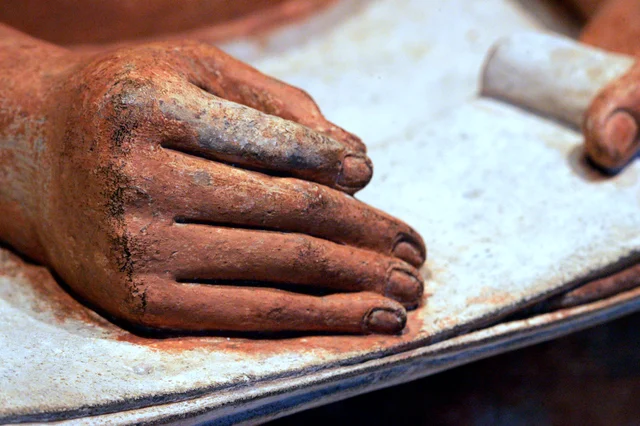
In Room 635 of the Louvre's Sully Wing — L'Ancien Empire, the Old Kingdom gallery — a limestone figure sits inside a glass vitrine and waits. He has been waiting, in one sense or another, since the moment he was made. He is cross-legged on the floor, his white linen kilt stretched taut across his lap. His left hand cradles a half-unrolled papyrus scroll. His right hand rests near the scroll's edge, thumb and index finger slightly curved — the grip a scribe takes before setting a reed pen to the page. The pen itself is gone. The papyrus has been blank for forty-five centuries.
He is 53.7 centimeters tall — roughly half life-size — and he weighs considerably less than he once did, since time has worn away much of the limestone dust that never needed to survive. But his eyes are intact. They are the first thing you notice, and they are very difficult to stop looking at. 1
The sculpture is accession number E 3023 in the Louvre's Département des Antiquités égyptiennes. Art historians call it Le Scribe accroupi, the Squatting Scribe or Seated Scribe. It was made, most likely, during the 4th Dynasty of the Egyptian Old Kingdom, somewhere between 2675 and 2545 BCE — the age of Khufu, Khafre, and the Giza pyramids. 1 It was found in 1850 by a French archaeologist in a shaft at Saqqara, the great necropolis south of ancient Memphis, and it arrived in Paris four years later. We do not know the man's name. We do not know what he looked like in life, or whether this sculpture resembles him at all. 2
What we do know is that whoever commissioned this statue intended it to last. They were right.
The world that made him
The Seated Scribe was made, almost certainly, in the administrative heart of the ancient world. 3 Memphis — the city the ancient Egyptians called Ineb-Hedj, "the white walls" — stood at the apex of the Nile Delta, where Upper and Lower Egypt met, and it served as the capital of the Old Kingdom throughout the 4th and 5th Dynasties. 3 If the statue dates to the 4th Dynasty, as the Louvre's stylistic analysis suggests, then it was carved during the reigns of Sneferu, Khufu, Djedefre, Khafre, and Menkaure — pharaohs whose monuments still dominate the Giza plateau. 4
Sneferu, the dynasty's founder (c. 2613–2589 BCE), built three pyramids — the Meidum Pyramid, the Bent Pyramid at Dahshur, and the Red Pyramid — and was the first Egyptian ruler to claim he was the embodiment of Ra, the sun god. 4 His son Khufu built the Great Pyramid at Giza, the only one of the Seven Wonders of the Ancient World still standing. Khafre added the second Giza pyramid and carved the Great Sphinx from the bedrock. Population of the entire country hovered around 1.6 million. The state's logistical apparatus — managing the labor, food, and material supply chains for these construction projects, while simultaneously administering taxes, trade, military deployments, and religious endowments — depended absolutely on one class of professionals. 3
Scribes.
The scribal statue, most likely, came from Saqqara — the vast plateau of mastaba tombs and underground galleries that served as the necropolis for Memphis. 5 Saqqara's oldest monument is the Step Pyramid of Djoser, built by the architect Imhotep in the 3rd Dynasty (c. 2650 BCE) — the first large-scale cut-stone building in history. Around and below it, mastaba tombs stretched in rows across the desert, each one a limestone superstructure above a subterranean burial shaft, built for a high official of the royal court. 5 This is almost certainly where our scribe was buried.
The man on the kilt: reading the sculpture
The Louvre has described the Seated Scribe's medium as painted limestone with inlaid eyes, wooden nipples, and a gesso underlayer. 1 Those technical details are accurate, but they understate how strange and immediate the result is.
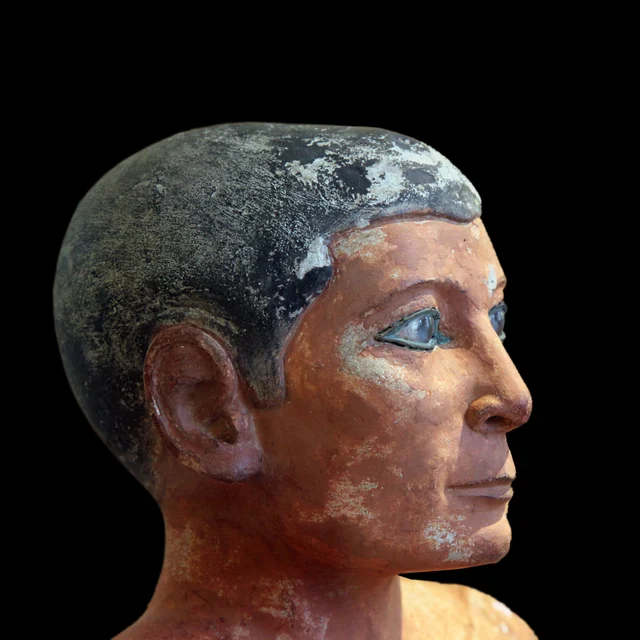
The figure is painted in the standard Egyptian polychrome scheme for men: red-brown skin, black hair and eye rims, a white kilt. 2 These conventions governed Egyptian art for three thousand years. What departs from convention is everything else. The body is soft, with visible rolls of belly fat and a slightly sagging chest — the body of a man who eats well and never does physical labor. The face has pronounced high cheekbones, slightly hollow cheeks, and a thin, composed half-smile — features that are not generic but specific, individual in the way that a portrait is individual. 6 The pose — cross-legged, torso tilted slightly forward, hands occupied — is one that a god or a king would never hold.
Old Kingdom royal statuary shows us a different kind of body entirely. The Khafre Enthroned statue at the Cairo Egyptian Museum depicts the pharaoh as a rigid, eternally youthful, perfectly symmetrical embodiment of divine perfection. His face is impassive. He does not look like a man who was ever hungry, tired, or uncertain. The Seated Scribe, by sharp contrast, looks like a man who has just exhaled. "He looks so relaxed," Dr. Steven Zucker of Smarthistory has said. 6
This departure is deliberate, not accidental. Dr. Beth Harris, also of Smarthistory, has explained the logic: "He's not idealized the way that we would see a figure of a pharaoh. The Egyptians considered pharaohs to be gods, and would never have represented the pharaoh in this relaxed, cross-legged position, and with the rolls of fat that help make him more human." 6 The Seated Scribe's soft body is not a failure of idealization — it is an idealization of a different kind. It signals, deliberately, that this man is wealthy enough to avoid manual labor. His prosperity is his status marker. His humanity is the point.
The hands reward close attention. Dr. Zucker has noted that "the sculpture has been carved with real delicacy. The fingers are long and elegant. The fingernails are carefully inscribed." 6 The right hand, with its slightly curled thumb and index finger, holds the phantom pen in the writing grip. The left hand supports the papyrus scroll — half-unrolled, ready. This is the posture of a scribe waiting to take dictation: professional readiness, frozen in limestone. "His right would have originally held a brush or a pen," Zucker has observed, "and his left holds a rolled piece of papyrus that he's writing on, which is interesting because it suggests the momentary, even though the Egyptians are so concerned with the eternal." 6
The sculptor maintained Egyptian convention in one critical respect: the figure is strictly frontal, designed to be viewed from the front, with near-complete left-right symmetry — the only significant asymmetry being the differently positioned hands. The kilt is subtly pleated at the edges, then painted flat white. The nipples — an unusual detail — are wooden dowels inserted into drilled holes in the chest, a naturalistic touch in an otherwise painted stone surface. 2 The base on which he sits is carved from the same limestone block as the figure itself, integrated rather than attached.
The original pigments were derived from natural minerals. Dr. Harris has noted that the amount of polychrome that survives is "rather unique" among ancient Egyptian painted sculptures. 6 Traces of the original blue-green paint remain on the papyrus scroll in the figure's lap. The Louvre's research laboratory has subjected the sculpture to analysis using the AGLAE ion beam accelerator (Accélérateur Grand Louvre d'analyse élémentaire), confirming the elemental composition of the eye inlays and pigments. 1
The eyes
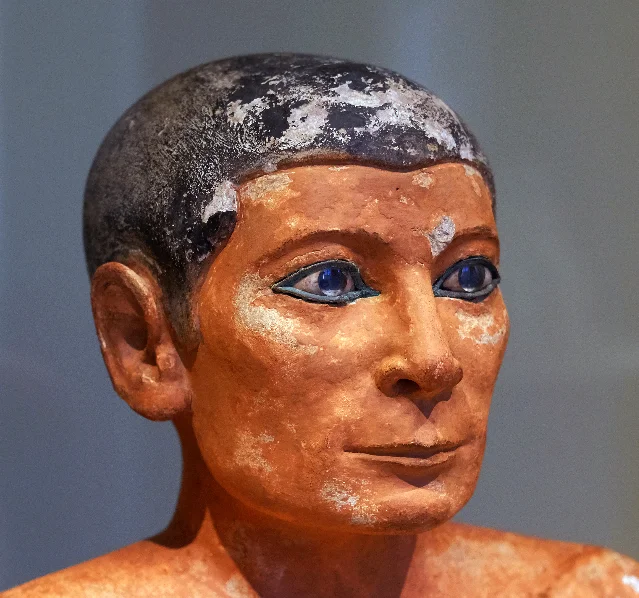
The eyes are the thing most people come for, and they do not disappoint at close quarters.
Each eye is a miniature engineering project. The sclerae — the whites — are carved from red-veined white magnesite (a form of magnesium carbonate), and polished to a smooth, slightly convex surface. 2 Set into each magnesite surround is a lens of polished rock crystal forming the cornea. The back surface of the crystal was coated with an organic material — a blue pigment mixed with an adhesive — which simultaneously created the iris color and bonded the assembly in place. The rock crystal itself carries a small carved indentation on its front surface to represent the pupil, giving it depth. Two copper-arsenic alloy clips hold each eye in the carved limestone socket from the rear. 2 The copper rims that outline the eye and lids emulate the black kohl eyeliner that elite Old Kingdom Egyptians wore — the cosmetic convention expressed simultaneously in paint and in metal. 7
The Louvre catalog records the material assembly in the terse language of conservation documentation: albâtre égyptien (sclérotique), cristal de roche (iris), cuivre (contour des yeux). 1 What those four words don't capture is the effect.
When light passes through the polished crystal from the front and bounces off the dark organic layer behind it, the result is a gaze that seems alert, present, and self-aware in a way that stone faces almost never are. Dr. Zucker has described the mechanism precisely: "That's because they're made of 2 different types of stone. Crystal, which is polished on the front, and then an organic material is added to the back that functioned both as an adhesive but also to color the iris. There's also an indentation carved to represent the pupil. All of this comes together to create a sense of alertness, a sense of awareness, a sense of intelligence that is quite present. It collapses the 4,500 years between when the sculpture was made and today." 6
This is not hyperbole. The technical achievement of the eye assembly is extraordinary even by modern standards — the sculptor was solving an optical problem (how to create the impression of a living iris in stone) through a layered solution involving four distinct materials, each contributing a specific property: opacity, transparency, color, and structural attachment. Egyptian sculptors had been developing this technique since at least the early 4th Dynasty, and they brought it to a peak here. There is a reason people stop walking when they reach this vitrine.
Who he was
The Seated Scribe bears no identifying inscription. 1
This is the central frustration of the object. Egyptian funerary statues of this type were almost always housed in serdabs — sealed statue chambers within mastaba tombs — or in offering chapels, and they were accompanied by inscriptions giving the subject's name, titles, and a list of the priestly duties that would ensure the ka received its offerings in perpetuity. The statue was a surrogate body: the ka could enter it and receive nourishment from the food offerings placed before it. For that system to work, the statue had to be correctly labeled. 8
The Seated Scribe's base — the semicircular platform on which he sits — was originally part of a larger inscribed block or architectural niche. It was cut, separating the statue from whatever text it once carried. When and why that happened, nobody knows. Dr. Harris has put the consequence plainly: "We would know more about him if the base on which he sits was not cut. It probably would have originally included his name and his titles." 6
Two scholarly candidates have been proposed. Pehernefer was a high official at the transition between the 3rd and 4th Dynasties, holding titles including Overseer of the Treasuries, Overseer of All Royal Works, and Overseer of the Royal Granaries — a senior administrator, exactly the kind of man who might have commissioned a prestige scribal statue. 9 Auguste Mariette, who discovered the Seated Scribe, initially attributed the statue to Pehernefer, whose own inscribed limestone statue was found nearby. The stylistic resemblances — the thin lips, the posture — have been noted, but no epigraphic evidence confirms the identification.
The second candidate, Kai, was a 5th Dynasty official whose mastaba tomb at northern Saqqara lay close to the findspot. 2 The proximity supports a 5th Dynasty date for the statue — as does an art-historical argument about scribal posture: art historians have observed that before the 5th Dynasty, scribes in Egyptian sculpture were typically depicted writing (right hand poised, papyrus ready), while scribes of the 5th Dynasty onward were more often shown in a reading position (hands resting). If that generalization holds, the writing posture here favors the earlier 4th Dynasty date — and pushes against Kai. 2
Neither attribution has been confirmed. Scholars classify both as speculative.
A third observation, less commonly noted, concerns the cross-legged pose itself. Some art historians have argued that this sitting position — directly on the floor, without a stool or throne — was restricted in the Old Kingdom to members of the immediate royal family. 8 If so, the Seated Scribe was not merely a high official but a man of royal blood, which would explain the otherwise unusual level of naturalistic attention lavished on a non-royal figure.
We will not know until someone finds the missing base — and even then, only if the inscription survived. NILE Magazine has put it as well as anyone: "until the tomb itself is rediscovered — hopefully with the missing base — the man who wished to be remembered as a person of sophistication will remain sadly anonymous." 7
The profession he served
Literacy in the Old Kingdom was, by any modern standard, a form of superpower. Egypt's population in 2500 BCE has been estimated at roughly 1.6 million. Of those, approximately 1% could read and write. 2 Scribes were among that fraction.
The profession was much more than clerical work. Scribes collected taxes, calculated the labor rosters for pyramid construction, tracked grain shipments and treasury disbursements, handled diplomatic correspondence in both Egyptian and foreign scripts, and maintained the priestly records that ran the religious foundations. 10 The archaeologist Kathryn A. Bard has noted that "although some members of the royal family and high status individuals, as well as officials, priests, and army officers were literate, scribes were needed for operations of the state at all levels." 10 In exchange for these services, scribes were exempt from manual labor, military conscription, and the taxes that fell on farmers and artisans. They were part of the royal court.
The scribal profession was hereditary. A scribe's son went to the temple school — the Per-Ankh, or House of Life — learned the same tradition his father had learned, and inherited his father's position. 10 The Egyptians called their writing system medu-netjer, "the gods' words" — it was Thoth, the ibis-headed deity of knowledge, who had invented writing, and Seshat, goddess of libraries, who kept a copy of every written work in the celestial archive. The act of writing was not merely communication. It was an act of creation that brought the invisible into visible reality. 11
The scribal culture produced what may be the most remarkable claim in ancient literature: that books outlast tombs. The Immortality of Writers (Papyrus Chester Beatty IV, New Kingdom, c. 1200 BCE) argues this case at length, naming the sages of the past — Imhotep, Ptahhotep, Hardedef — who survive not because their monuments are standing but because their texts are still read: "Man decays, his corpse is dust, all his kin have perished; but a book makes him remembered through the mouth of its reciter." 11 The Papyrus Lansing advises young men directly: "Befriend the scroll, the palette. It pleases more than wine. Writing for him who knows it is better than all other professions." 12
The Seated Scribe, as a funerary statue, embeds this belief in stone. His ka — the life force that ancient Egyptians believed inhabited the body and survived death — would take up residence in the statue and continue its eternal scribal work, seated cross-legged, papyrus ready. The sculptor chose to depict the scribe not reading (a reflective, completed activity) but writing — a present-tense act, ongoing, the pen about to touch the page. The profession continues. The offering of food and libation placed before the vitrine niche keeps the ka fed. The scroll is always about to be filled.
From the shaft at Saqqara to the Sully Wing
The statue sat in the dark for something between 4,200 and 4,350 years.
Auguste Mariette (1821–1881) arrived in Egypt in October 1850 on an official Louvre mission to acquire Coptic, Syriac, Arabic, and Ethiopic manuscripts. 13 He was not supposed to excavate anything. Within weeks, he had arranged a 30-man labor crew and begun digging at Saqqara. His entry point was a single sphinx's head he noticed poking from the sand at the edge of the dromos — the avenue of sphinxes leading to the Serapeum, the vast underground cemetery where the sacred Apis bulls had been interred. He recognized it as the beginning of something much larger.
The Serapeum excavations that followed made Mariette famous. He spent four years at Saqqara, and the finds arrived in Paris by the boatload — literally: 5,964 objects shipped to France between 1852 and 1853, filling 230 crates for the Louvre and an equal number for the Egyptian collections remaining in Cairo. 13 This was the partage system: a formal division of excavated material between the excavating nation and the host country, which governed European museum collecting in Egypt throughout the 19th century. 14
The Seated Scribe was found on 19 November 1850, in a shaft (a vertical excavation pit) located north of the Serapeum's sphinx avenue — the Louvre catalog gives the findspot as dans un puits situé au nord du Sérapéum. 1 How it came to be in that shaft — whether it was the original deposition site within the mastaba complex or had been moved at some point in antiquity — is unknown, because Mariette's excavation journals were never returned to him and are now lost. 13 A flood at the Bulaq Museum in Cairo in 1878 destroyed most of his surviving notes and drawings. His posthumously published work, Les mastabas de l'ancien empire (1888), was reconstructed from incomplete records, and provides only partial context for the individual finds. 13
Mariette's reaction to the discovery was documented in his own words. Having spent time in Egypt and been forced back to Paris, he was consumed by the need to return: "I knew I would die or go mad if I did not return to Egypt immediately." 13 He did return — permanently. In 1858, the Egyptian viceroy Sa'id Pasha appointed Mariette as the country's first Director of Antiquities, a position he held until his death in 1881. He founded what would become the Egyptian Museum in Cairo. The man who discovered the Seated Scribe spent the rest of his life protecting the country that produced it.
The Louvre acquired the statue by purchase from Mariette himself — he is listed in the formal acquisition record as both excavator and vendor. 1 The transaction was completed on 16 December 1854, more than four years after the discovery — a gap that reflects the logistics of shipping, documenting, and processing thousands of objects. The statue was assigned accession number E 3023, with alternates N 2290 and IM 2902. Current legal title is held by the French State and assigned to the Musée du Louvre. 1
The Louvre's Egyptian department had been founded by royal decree on 15 May 1826, under the directorship of Jean-François Champollion — who had deciphered hieroglyphics in 1822 and was the natural choice to build the collection. 14 The Seated Scribe entered an institution that was, in 1854, only beginning to understand what it held. The first serious scholarly monographs on Old Kingdom private statuary would not appear for decades. The statue went on display in the Louvre's south wing. Today it occupies Vitrine 10 in Room 635, the Old Kingdom gallery in the Sully Wing, Level 1, where it has been since the department's reorganization. 1
It has never left France. Between February 2022 and January 2023 it was on exceptional loan to Louvre-Lens, the Louvre's satellite museum in northern France — the only time in 170 years it has traveled. 8 It came back to Room 635, sat back down, and resumed waiting.
The gaze that collapses time
The art-historical significance of the Seated Scribe lies precisely in the tension that runs through every inch of it: the sculptor obeyed Egyptian convention in structure (frontality, color scheme, funerary function) and broke it in observation (soft body, individual face, momentary professional gesture). 15 This was not a general Old Kingdom trend. The royal workshop tradition of the 4th Dynasty produced both the Khafre-type idealized divine portrait and, for private non-royal subjects, something more observational — what some scholars have called a distinct mode of portraiture that prioritized the particularity of a specific living person over the generic divine ideal. 2
The Seated Scribe is the best-preserved example of that style in existence, and it is classified as a masterwork of the Old Kingdom not because it exemplifies Egyptian convention but because it departs from it with such precision. 8 Christiane Ziegler, the Louvre curator who produced the definitive catalog of Old Kingdom statuary in 1997 and a dedicated monograph on this statue in 2002, situated it at the peak of a brief naturalist moment in Egyptian sculpture — a window that closed, somewhat, as the 5th Dynasty moved toward a blockier, more stylized treatment of private figures. 1
The bibliography now runs to over a hundred scholarly publications in French, English, and German. The sculpture appeared in the international loan exhibition "Egyptian Art in the Age of the Pyramids" (Paris, New York, Toronto, 1999–2000). It has been cited in studies of Picasso and Giacometti's relationships with Egyptian art, and referenced in the context of Degas's interest in Egyptian sculpture. The AGLAE ion beam analysis continues to generate data. 1
None of that changes what happens when you stand in front of Vitrine 10. The scholar's argument for the statue's importance is entirely consistent with a simpler observation: those eyes are looking at you. They have been looking at visitors since 1854. Before that, they looked at the inside of a shaft in the Saqqara sand for four-plus millennia. Before that — when the reed pen was still in the right hand and the papyrus still in the left and someone was about to begin dictating — they looked at someone whose voice we will never hear, recording something we will never read.
"It collapses the 4,500 years between when the sculpture was made and today." 6 That is what the eyes do. The man we cannot name commissioned a piece of limestone that would preserve his professional self for eternity. He got what he paid for.
| Detail | Value |
|---|---|
| Title | The Seated Scribe (Le Scribe accroupi) |
| Accession | E 3023 (also N 2290, IM 2902) |
| Date | 4th Dynasty, Old Kingdom, c. 2675–2545 BCE (attributed by style; 5th Dynasty also proposed) |
| Medium | Painted limestone with inlaid eyes (magnesite, rock crystal, copper-arsenic alloy), wooden nipples |
| Dimensions | 53.7 × 44 × 35 cm |
| Discovered | 19 November 1850, Saqqara-Nord, by Auguste Mariette |
| Acquired | 16 December 1854, purchased from Mariette |
| Current location | Louvre, Sully Wing, Level 1, Room 635, Vitrine 10 |
| Identity | Unknown; candidates: Pehernefer (4th Dynasty) or Kai (5th Dynasty) — neither confirmed |
Cover image: The Seated Scribe (E 3023), full front view, Musée du Louvre. Photo: Roland Unger, CC BY-SA 3.0 via Wikimedia Commons.
参考来源
- 1Louvre Collections: Le scribe accroupi (E 3023)
- 2Wikipedia: The Seated Scribe
- 3Wikipedia: Old Kingdom of Egypt
- 4Wikipedia: Fourth Dynasty of Egypt
- 5Wikipedia: Saqqara
- 6Smarthistory: The Seated Scribe (via archive.org)
- 7NILE Magazine: Who is The Louvre's Seated Scribe?
- 8Grokipedia: The Seated Scribe
- 9Wikipedia: Pehernefer
- 10Wikipedia: Scribe — Ancient Egypt
- 11World History Encyclopedia: Immortality of Writers in Ancient Egypt
- 12World History Encyclopedia: The Papyrus Lansing — Be A Scribe...Or Else!
- 13Wikipedia: Auguste Mariette
- 14Wikipedia: Department of Egyptian Antiquities of the Louvre
- 15Art History Teaching Resources: Art of Ancient Egypt
围绕这条内容继续补充观点或上下文。