Your desk is a nutrition system — whether you designed it or not

Your desk is a nutrition system — whether you designed it or not

By mid-afternoon, your prefrontal cortex is depleted and willpower has left the building. Research shows that proximity and visibility of food determine what you eat far more than any intention — workers ate 2.2 more pieces of candy per day just because it was visible, and snacking likelihood jumps over 50% when food is closer to where you sit. This guide explains the proximity effect, gives you a complete desk drawer snack list (shelf-stable, no meal prep), and lays out a 5-minute weekly restock protocol that makes good nutrition the default — not the exception.

Daily Fuel for Peak Performance
2026/6/9 · 8:11
1 订阅 · 3 内容

Your desk is a nutrition system — whether you designed it or not 🧠⚡

You already know what you should eat. The reason it doesn't happen at 3pm on a Tuesday isn't knowledge — it's architecture.
By mid-afternoon, you've fielded dozens of emails, made a string of small decisions, held at least one meeting you could have survived as an email, and your prefrontal cortex is running on fumes. Research shows that repeated decision-making progressively degrades judgment quality — a pattern frequently observed in food-choice studies, where people are more likely to reach for high-calorie, low-effort options as the day goes on. 1
In that state, willpower isn't a strategy. What you eat at 3pm is largely determined by what's already within arm's reach.
This is the one environment design change that costs fifteen minutes, requires no meal prep, and directly shapes your cognitive performance for the rest of the workday.

The proximity effect: what's close gets eaten

In a now-classic study, 40 office workers were observed over four weeks under different conditions: chocolates placed on their desks versus 2 meters away, and in transparent versus opaque containers. When the candy was visible, workers ate 2.2 more pieces per day. When it sat on the desk rather than across the room, they ate 1.8 more pieces per day. 2
Critically: participants underestimated how much they ate when food was close, and overestimated how much they ate when it was far away. Proximity distorts self-awareness.
A separate field study, conducted at Google's New York office, found that placing snacks closer to the beverage station — just a few feet — increased the likelihood of snacking by more than 50%. 3
The takeaway isn't complicated: your environment selects your food choices before your conscious brain gets a vote. So the only real question is whether you set up that environment deliberately.
正在加载统计卡片…

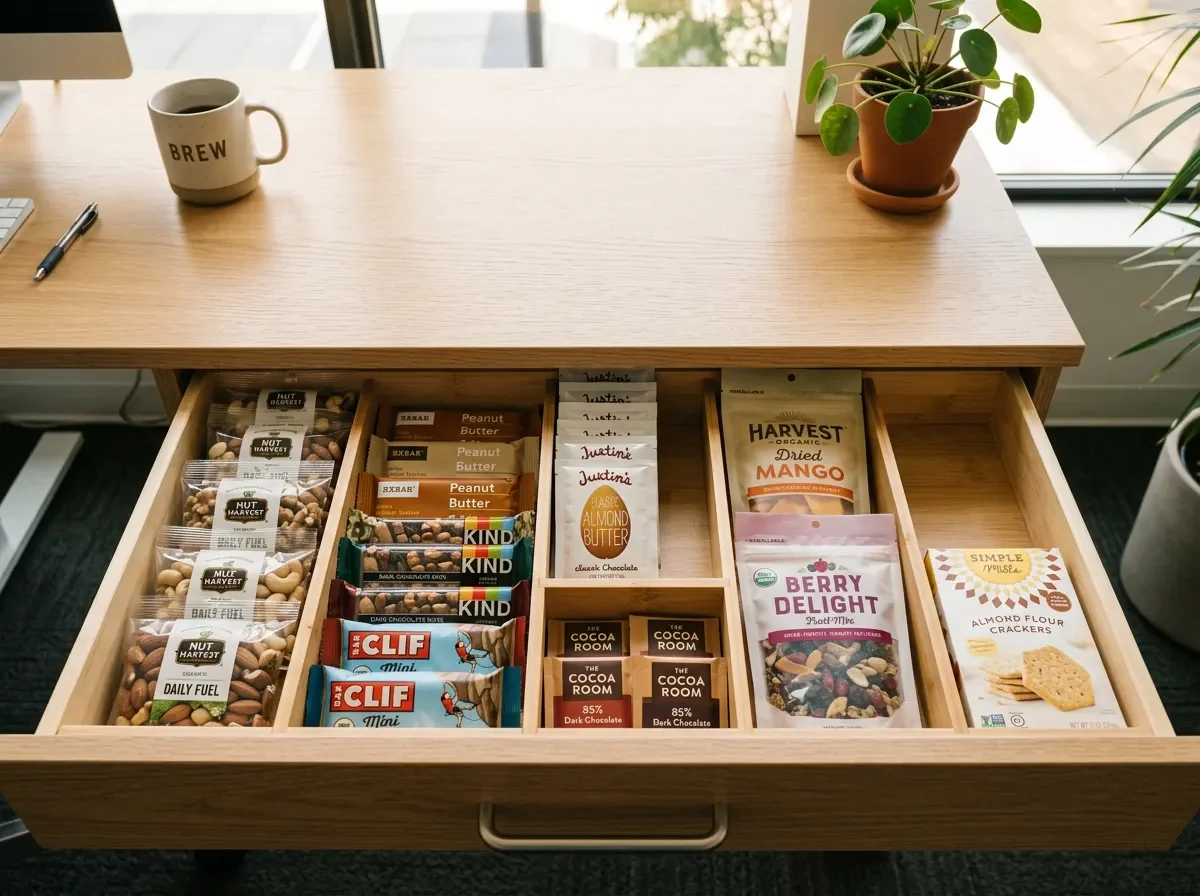
What a functional desk snack drawer actually contains

The goal isn't a clean drawer with virtuous intentions. The goal is a drawer where every item inside does specific metabolic work aligned to the five-window framework.
Here's the selection logic: snacks should cover the bridge window (10–11am) and the strategic window (3–4pm) — the two highest-failure points in a typical workday. Each snack needs to deliver protein to blunt appetite and support neurotransmitter production, fiber to slow glucose absorption, and a fat source to extend energy release. This is the Power Snack Formula from Day 1.
The items below require zero refrigeration and survive months in a desk drawer:
ItemWhy it worksNotes
Individual nut packets (almonds, walnuts, cashews)Protein + monounsaturated fats + minimal glucose impact1-oz servings (roughly 23 almonds) are the right portion
Roasted chickpeasProtein + fiber combo in one itemLower fat than nuts, more filling per calorie
Single-serve almond butter packetsProtein + fat without the calorie density spikePairs with crackers or eaten solo
Seed crackers / whole-grain crackersFiber + complex carbs; extends other snacksLook for ≥3g fiber per serving
Dark chocolate squares (70%+)Small fat + flavonoid hit; reduces cravings for sweeter alternatives1–2 squares, not a bar
Beef jerky or turkey sticksHigh protein, portable, shelf-stableWatch sodium; aim for <400mg per serving
Individual nut and seed bars (RXBar, LARABAR)Protein + fiber without added sugarsRead labels — many "protein bars" are candy bars
The water bottle lives on the desk, not in the bag. Everything else that creates friction lives somewhere harder to reach.
Mixed nuts — a high-protein, shelf-stable desk staple for the 10am and 3pm windows
Mixed nuts — a shelf-stable, high-protein option for the 10am bridge and 3pm strategic windows 4

The two-minute setup protocol

This is the only "habit" the system asks of you — done once, not every day:
1. The drawer audit (5 minutes, once a week) Before Monday starts, open the drawer. Remove anything that isn't performing (the granola bar wrapper, the leftover Halloween candy, the coffee creamer packets). Restock what's running low. The act of restocking is a decision made in advance, when you're not depleted.
2. The proximity rule Healthy options go in the top drawer or within arm's reach of where you sit. Anything you'd rather not reach for goes somewhere that requires getting up — the break room, a bottom shelf, your bag in the closet. You're not removing options; you're adding distance.
3. The hydration anchor Water bottle front-and-center on the desk, filled every morning. Most mid-morning hunger signals before 10:30am are actually mild dehydration. Making water the default reach-for item handles this before it becomes a snack decision.

How this fits the five-window framework

You've built the framework, you understand the timing — but timing-based eating only works if the right food is available at that time. The drawer is what closes that gap.
  • 10–11am bridge window: grab one nut packet or almond butter + a few crackers before the calendar fills with back-to-back calls.
  • 3–4pm strategic window: dark chocolate square + roasted chickpeas, or a nut-and-seed bar if the morning was heavy and lunch was light.
Neither requires a decision in the moment. That's exactly the point. The decision was made during the five-minute Sunday or Monday restock.
正在加载图表…
Relative in-the-moment decision load per eating window — stocked drawer removes the daily choice entirely.

The micro-habit that builds the system

One behavior sustains everything: add a recurring 5-minute "drawer restock" block to your Monday morning calendar.
Not a goal. Not an intention. A calendar block — because what gets scheduled gets done, and what requires in-the-moment willpower gets skipped.
The proxy goal here isn't "eat healthier." It's "never be in a situation where the nearest available food is a vending machine or someone's leftover birthday cake." Proximity predicts consumption. Control proximity, and you've taken the decision out of your depleted afternoon hands.

🥑 Your turn: What's currently living in your desk drawer right now — and would you say it's working for you or against you in the 3pm window? Drop your current setup in the comments.

围绕这条内容继续补充观点或上下文。

  • 登录后可发表评论。