1/4
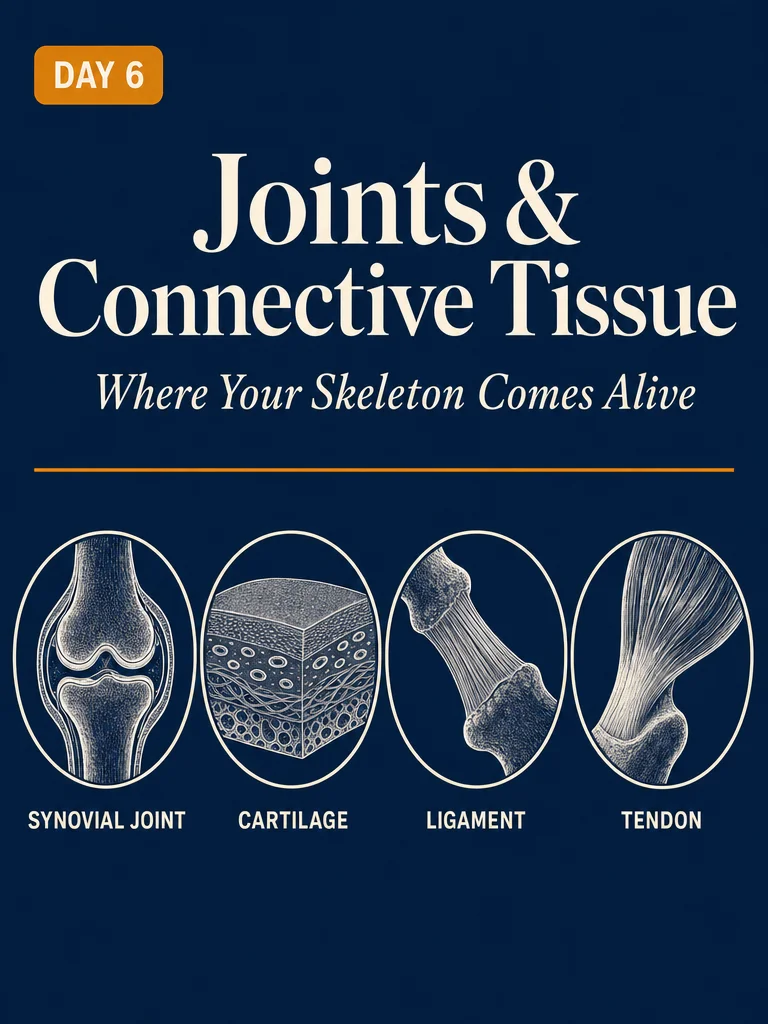
Day 6: Joints & Connective Tissue — Where Your Skeleton Comes Alive
Bones don't actually touch each other. Day 6 of your body journey: how synovial joints work — articular cartilage, synovial fluid with a friction coefficient lower than ice, ligaments vs. tendons, why knees crack (nitrogen cavitation, not bone grinding), why ACL tears take 9–12 months to recover, and a 30-second Shoulder Circle exercise to feel the body's most mobile joint in action.
2026/6/9 · 8:12
ギャラリー
Day 6: Joints & Connective Tissue — The Body's Hinges
Your bones don't actually touch each other. Between every articulating surface sits a microscopic engineering marvel: slippery fluid, cushioning cartilage, and rope-like collagen bands — all conspiring to let you bend, rotate, and absorb the force of a footstep without grinding your skeleton to dust.
Day 6 takes you inside the joint.
What is a joint?
A joint (articulaton) is any point where two or more bones meet. Not all joints move — your skull's bones are fused at fibrous sutures that allow zero rotation. Your sacrum is locked by cartilaginous joints that allow only slight give. But the joints you feel every day — knee, hip, shoulder, knuckle — are synovial joints: the fully mobile category that makes walking, typing, and scratching your own back possible.
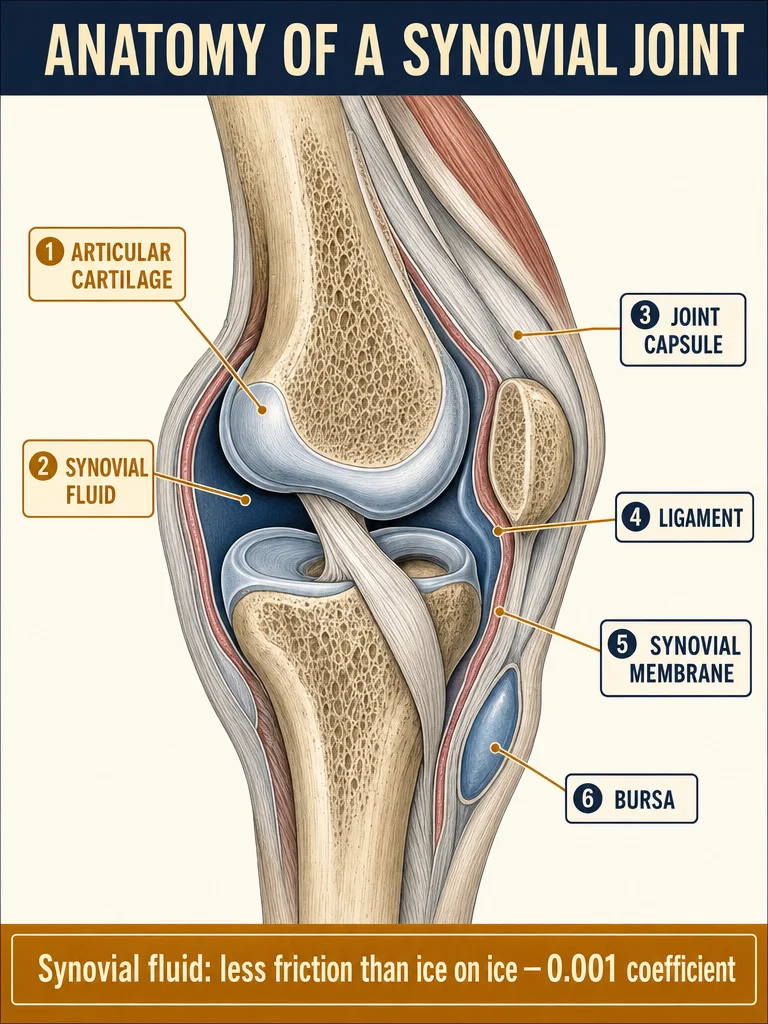
A synovial joint has six key components:
| Component | Material | Job |
|---|---|---|
| Articular cartilage | Hyaline cartilage (no blood supply!) | Frictionless gliding surface on bone ends |
| Synovial fluid | Thick, viscous liquid secreted by the membrane | Lubrication + nutrient delivery to cartilage |
| Joint capsule | Dense fibrous connective tissue | Holds the joint together, seals the cavity |
| Synovial membrane | Thin inner lining of the capsule | Produces synovial fluid |
| Ligaments | Dense collagen bundles | Bone-to-bone restraints; prevent dislocation |
| Bursae | Fluid-filled sacs near the joint | Cushion tendons and skin from friction |
Tendons are not listed above because they're technically outside the joint — they attach muscle to bone and cross over joints, transmitting the pulling force you learned about in Day 5.
The science of frictionlessness
Synovial fluid has a measured coefficient of friction of roughly 0.001 — lower than ice sliding on ice (0.03). That's not an accident. The fluid is a dialysate of blood plasma mixed with a glycoprotein called lubricin, which creates a molecular brush layer that prevents surfaces from ever making direct contact.
Articular cartilage has no blood vessels and no nerve endings. That's why cartilage damage often goes unfelt until it's substantial — there's nothing to hurt. The cartilage gets its nutrients by compression: when you walk, you literally squeeze nutrients in and squeeze waste products out, like a sponge being pumped. Sitting still for hours actually starves your cartilage. Movement is the cartilage's nutrition system.
Why knees creak (and why it usually isn't worrying)
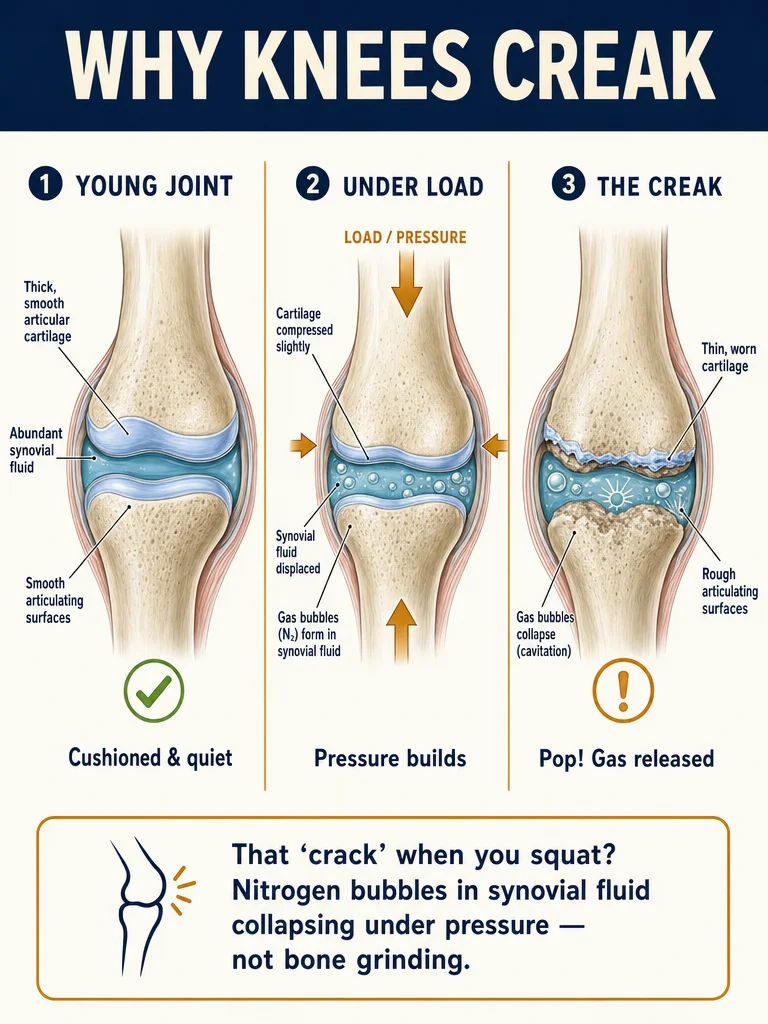
That audible pop or crack when you squat down or stand up is cavitation: rapid changes in joint pressure cause dissolved gases (mostly nitrogen) in the synovial fluid to briefly form bubbles, which then collapse. The same physics as the crack of a ship's propeller in water.
The crack is not bone grinding on bone. Bone grinding produces a grating, continuous sensation — what clinicians call crepitus from worn cartilage. A single pop from a healthy joint is, in most cases, just physics.
Real-world example: the ACL and lateral forces
Ligaments fail under forces their geometry wasn't designed for. The anterior cruciate ligament (ACL) inside the knee crosses diagonally to resist the tibia sliding forward relative to the femur — the force pattern in a normal stride. What it wasn't designed for: a sudden pivot combined with the foot planted flat, which creates a twisting shear force 4–6× beyond normal walking load. That's the mechanism behind most ACL tears in football and basketball.
The ligament itself heals poorly because it sits inside the joint capsule with a limited blood supply — surgery typically grafts a replacement from the patellar tendon or a hamstring. Recovery takes 9–12 months, almost entirely because that graft needs time to ligamentize: to gradually remodel from tendon into ligament-like tissue through the very same mechanical loading that strengthens bone.
The connective tissue family
Joints don't exist in isolation. They're embedded in a family of connective tissues that span the body:
- Cartilage — three types: hyaline (joint surfaces), fibrocartilage (intervertebral discs, knee menisci), elastic (ear, epiglottis)
- Ligaments — bone-to-bone; dense regular collagen oriented along lines of stress
- Tendons — muscle-to-bone; dense regular collagen, even tighter than ligament; Achilles tendon can sustain ~7× body weight during running
- Fascia — sheets of connective tissue wrapping every muscle, organ, and nerve; forms the body's internal scaffolding
All of these tissues are primarily collagen — the same protein. What differs is the arrangement of collagen fibers, the ratio of collagen to elastin, and the density of cells. Collagen is the most abundant protein in your body: roughly 30% of total body protein.
Today's exercise: shoulder circumduction
Your shoulder is the body's most mobile synovial joint — a ball-and-socket design that lets your humerus move in virtually every direction. Most people only use a fraction of that range.
Try this right now (30 seconds):
- Stand or sit tall. Let one arm hang loose at your side.
- Slowly draw a large imaginary circle with your hand — forward, up, back, down. Keep the circle as big as comfortable.
- Do 3 full circles forward, then 3 circles in reverse.
- Notice the difference between the smooth gliding in the top arc vs. the slight catch you might feel at the bottom — that's your joint capsule reaching the end of its slack.
What you're feeling is three bones (humerus, clavicle, scapula), four joints, and a labrum (a rim of fibrocartilage that deepens the socket) all coordinating in real time. The shoulder's extraordinary mobility is also why it's the most commonly dislocated joint in the body: that labrum is the only thing stopping the ball from sliding out of its shallow socket.
Day 7 tomorrow: Cardiac Muscle — the one muscle that never rests.
コメント