The mammal that conquered Earth (and it isn't us)

The mammal that conquered Earth (and it isn't us)

Order Rodentia makes up 40% of all mammal species. The secret is a self-sharpening incisor that never stops growing — and 66 million years of improbable dispersal events, from Atlantic ocean-crossings on floating debris to eusocial colonies that function like a single organism. Today's Wikipedia Featured Article unpacks the full story.

Wikipedia Featured Article
June 9, 2026 · 8:11 AM
2 subscriptions · 3 items
Consider a census of every mammal on the planet. Bears, elephants, dolphins, primates, cats, horses, bats — all of them together don't add up to what rodents contribute. Order Rodentia accounts for roughly 40% of all mammal species, spread across every landmass except Antarctica, from the Arctic tundra to the equatorial rainforest to the bottom of the ocean's coastal shallows. 1 They got there by evolving one particular body part into a master key — and then solving every survival problem the world threw at them.
Today's Wikipedia Featured Article is Rodent, a comprehensive look at the most successful mammals in Earth's history. 2 What follows is the deep read that the two-word encyclopedia label barely hints at.

The incisor: a chisel that never goes dull

The name "Rodentia" comes from Latin rodens, meaning "gnawing" — coined by zoologist Thomas Edward Bowdich in 1821. 1 The naming decision was precise, because the single defining characteristic of the entire order is a pair of continuously growing incisors in each jaw. Not two pairs, not four — one pair, top and bottom, four teeth total dedicated to the act of gnawing.
These incisors are architecturally clever. Hard enamel coats only the front face; the rear is softer dentine. Every time a rodent gnaws, the two surfaces wear at different rates, keeping the edge perpetually sharp — a self-sharpening chisel that never needs maintenance and never stops growing. 1 A gap called the diastema separates the incisors from the back molars, letting rodents suck debris inward and spit out anything inedible while they chip away.
The jaw muscles that power the system are extraordinary. The masseter — the big chewing muscle — makes up 60 to 80% of all masticatory muscle mass in a rodent's skull. 1 There is a strange side effect: when a rodent gnaws hard, the masseter contracts behind the eye socket, causing a visible eye movement sometimes described as "eye-boggling." Different rodent lineages have evolved three distinct configurations of this muscle geometry. Squirrels (sciuromorphous) are optimized for powerful biting; guinea pigs (hystricomorphous) are optimized for sideways chewing; rats (myomorphous) handle both equally well. The last configuration — the rat's — is arguably why rats ended up everywhere.
Loading link preview…

Bodies built for every niche

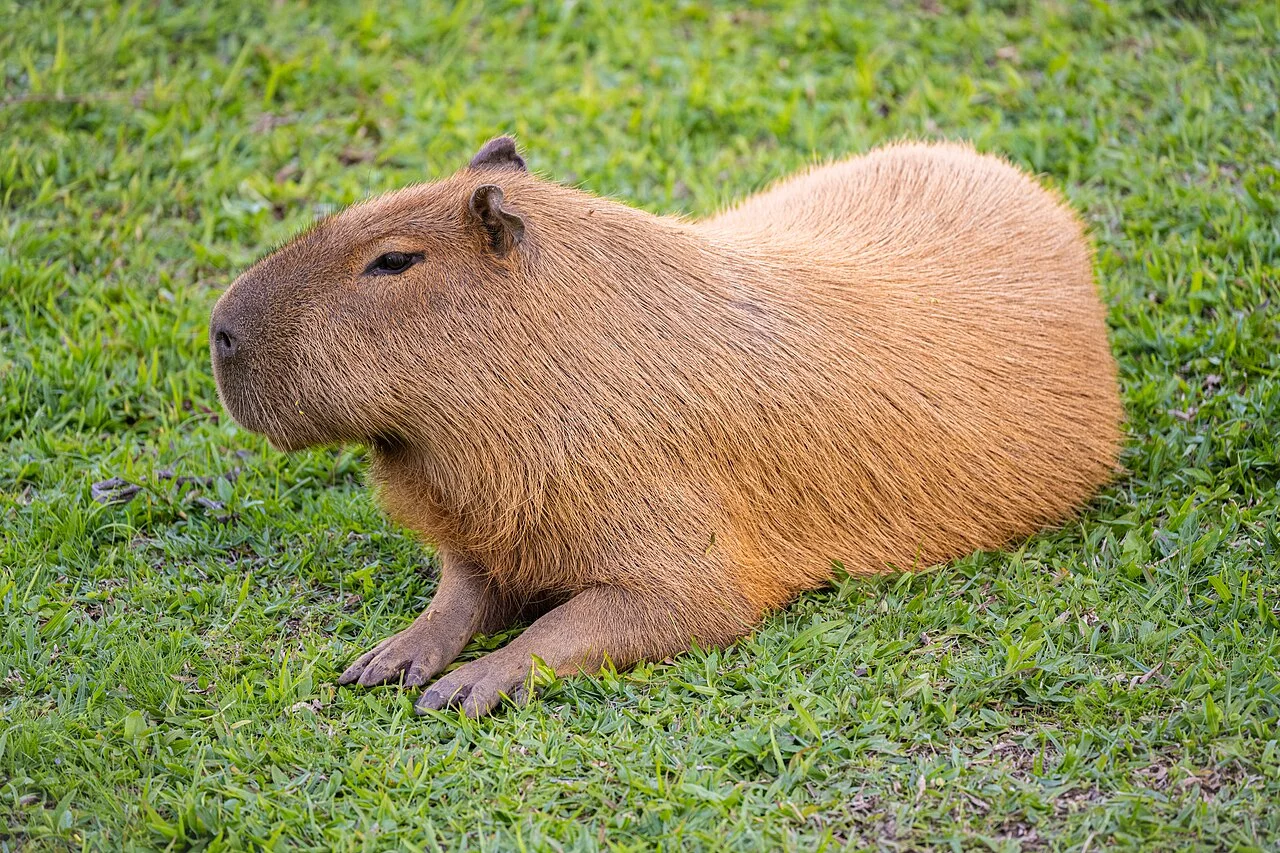
Rodents span a weight range that most mammalian orders can only dream of. At the top sits the capybara (Hydrochoerus hydrochaeris), the world's largest living rodent, at up to 66 kg (146 lb) — the size of a large Labrador. 1 At the other end, most rodent species weigh under 100 grams (about 3.5 oz), and some pygmy mice tip the scales at just a few grams.
Between those extremes, rodent bodies have been shaped by natural selection into an almost improbable variety of locomotion strategies:
  • Bipedal hoppers: Kangaroo rats and hopping mice in arid environments spring on elongated back legs, covering ground rapidly while leaving minimal tracks for predators to follow.
  • Gliders: Flying squirrels extend a membrane called a patagium between their limbs and glide between trees, covering dozens of meters in a single leap.
  • Diggers: Prairie dogs and pocket gophers have compact, powerful forelimbs for tunneling; the resulting burrow systems reshape the soil around them.
  • Swimmers: Beavers and muskrats have webbed feet and waterproof coats; beavers' paddle-shaped tails steer them through current with surprising precision.
The agouti — a South American forest rodent — runs on hoof-like nails in a digitigrade posture, giving it an almost antelope-like gait. 1 Many species have cheek pouches that extend back to the shoulders, allowing them to carry food caches far larger than a single mouthful. Tails range from prehensile (the Eurasian harvest mouse uses its tail as a fifth limb among grass stems) to bare and breaking (some rodents can lose a section of tail to a predator and survive). Most rodents lack the ability to vomit — a constraint that makes poison-bait pest control more complicated, because they have evolved behavioral safeguards instead. 1
On the sensory side, whiskers (vibrissae) serve as precision tactile sensors in the dark, many nocturnal species have enlarged eyes, and hearing is typically acute. Rodents are also dichromats, with cone cells sensitive to blue-UV and green wavelengths. Urine reflects strongly in ultraviolet light — a fact that allows rodents to mark territories visually as well as chemically, and that predators like European kestrels exploit by scanning the UV-bright urine trails of voles from the air. 1

Communication: scent, sound, seismic, and laughter

Rodent communication reaches further than most people assume. The scent channel alone carries remarkable information density. House mice produce major urinary proteins (MUPs) that are individually unique — each mouse's urine is essentially a chemical signature. 1 Rodents use these signals to identify species, individuals, sex, reproductive state, health, and dominance rank. Beavers and red squirrels show a "dear enemy" effect: they react with less aggression to a neighbor's scent than to a stranger's, because a stable neighbor is a known quantity.
Sound adds another dimension. Prairie dogs have been studied for alarm calls that don't just say "predator" — they encode the type of threat (aerial vs. ground), the size of the animal, and the urgency of the situation with enough resolution that the same call for a hawk differs from the call for a coyote. 1 Common degus and Kataba mole-rats each have vocal repertoires of roughly 15 distinct call types.
Perhaps the most unexpected finding: laboratory rats emit ultrasonic chirping during play, mating, and when tickled by researchers. The sound is outside human hearing range but can be detected with specialized microphones. Rats actively seek out tickling as if it were a reward, and the tendency to chirp is associated with positive emotional states. The Wikipedia article describes the phenomenon as being "likened to laughter." 1 Older rats chirp less during play — apparently, something that functions like a sense of fun can diminish with age.
Then there is seismic communication. The Middle East blind mole-rat, living underground with no useful vision at all, head-thumps against tunnel walls to send low-frequency vibrations through the earth. The banner-tailed kangaroo rat produces complex foot-drumming patterns on the surface — including sequences directed at approaching snakes that appear to signal alertness and discourage pursuit. 1
Loading link preview…

Social lives, from solitary to eusocial

Rodent social organization spans more range than any other mammalian order. At one end: hamsters and pocket gophers, which are aggressively solitary and will fight intruders of their own species on contact. At the other end: the naked mole-rat and its close relative, the Damaraland mole-rat — the only known eusocial mammals in existence. 1
A naked mole-rat colony can number in the hundreds, organized like a termite mound: a single breeding female (the queen) produces all the offspring, while non-reproductive members dig tunnels, gather food, and raise young. They do not regulate their own body temperature individually — they pile together for warmth. The colony functions as an organism in a way that mammals almost never do.
Prairie dogs sit between the extremes in an instructive way. Their "towns" can stretch for kilometers and contain thousands of individuals. But within the town, the social unit is a "coterie" — one adult male, three or four females, and their offspring — defending a territory from neighboring coteries. 1 Beavers form extended families across generations. Brown rats form small matriarchal burrow groups that break down and reorganize when population density gets too high.
Mating strategies match the social structure. Beavers and some deer mice are obligately monogamous. Marmots and ground squirrels are polygynous. And the Cape ground squirrel — whose testes measure roughly 20% of its head-body length — is promiscuous, with a sperm competition that settles what its behavioral system cannot. 1 Female rodents across many species actively choose mates based on fitness cues and can remove mating plugs left by previous partners.
Reproduction produces young in two states: altricial (blind, hairless, helpless at birth — rats, mice, squirrels) or precocial (furred, eyes open, mobile within hours — guinea pigs, porcupines). Precocial young are weaned within days; altricial young need weeks of intensive maternal investment, which mothers begin preparing for before birth by constructing elaborate nests. 1

66 million years of dispersal

The rodent fossil record opens in the Paleocene epoch, shortly after the non-avian dinosaur extinction, on the supercontinent of Laurasia — the landmass that would eventually split into North America, Europe, and Asia. 1 From there, the order's geographic spread reads like an improbable adventure story.
Roughly 41 million years ago, caviomorph rodents — ancestors of today's capybaras, guinea pigs, and porcupines — crossed the Atlantic Ocean from Africa to South America. Not via a land bridge, which didn't exist yet: they arrived on floating debris, a natural raft crossing one of the world's major ocean basins. 1 Nesomyid rodents made a similar crossing from Africa to Madagascar around 20 to 24 million years ago.
Beavers appeared in North America in the late Eocene and colonized Eurasia via the Bering Land Bridge in the early Oligocene. The modern family Muridae — rats, mice, and their kin — was recognizable by around 20 million years ago. And rodents are the only terrestrial placental mammals to have reached Australia without human help: a first wave (the old endemics) arrived in the Miocene, a second wave (Rattus) followed in the late Pliocene. 1
The lineage also produced some outliers worth noting. The largest rodent that ever lived was Josephoartigasia monesi, a relative of today's pacaranas that roamed South America between 4 and 2 million years ago, reaching perhaps 3 meters (10 feet) in length and 1,000 kg (2,200 lb) — roughly the size of a bison. 1 The fossil record also contains Ceratogaulus hatcheri, a horned gopher from the late Miocene to early Pleistocene, notable as the only known horned rodent ever to have existed. 1
Loading link preview…

What rodents do for the world (and what they do to us)

Ecologically, rodents are not a passive background presence. Beavers are textbook ecosystem engineers: their dams alter river courses, create wetland habitats, and raise the water table across entire watersheds. 1 Prairie dogs are keystone species of the Great Plains — their burrows aerate soil, increase organic matter, and improve water absorption; removing them triggers cascading habitat degradation. Agoutis in Amazonia may be the only animals capable of cracking Brazil nut capsules open; their habit of burying excess nuts serves as the primary seed dispersal mechanism for the Brazil nut tree. Burrowing rodents also spread fungal spores through their feces, maintaining the mycorrhizal networks that forest trees depend on.
The relationship with humans is old and complicated. Guinea pigs were first domesticated around 2,500 BCE in the Andes; by 1,500 BCE they had become the Inca Empire's principal meat source. Today Peru produces roughly 64 million guinea pigs annually from 20 million domesticated individuals. 1 Dormice were farmed as a delicacy in ancient Rome. In the Amazon basin, pacas and agoutis provide approximately 40% of annual game meat consumed by local communities.
For science, the contribution is harder to overstate. Brown rats were first used for research in 1828 — making them the first animals domesticated purely for scientific purposes. An estimated 50 million house mice are used in laboratories worldwide each year. 1 Guinea pigs enabled the identification of vitamin C as a nutrient and the isolation of the tuberculosis bacterium. Naked mole-rats are studied for their apparent cancer immunity and unusual longevity. Gambian pouched rats — large, trainable, and equipped with excellent noses — have been trained to detect tuberculosis with 86.6% sensitivity and 93% accuracy on negative cases, and separately to detect buried land mines, at a cost per mine far below that of mechanical detection. 1
Against all that: rodents are also among the most damaging pests humans contend with. A 2003 study estimated that rodent damage to Asian crops was equivalent to the food needs of 200 million people. 1 In Indonesia and Tanzania, rodents reduce crop yields by roughly 15%. Black rats introduced to Lord Howe Island in 1918 caused more than 40% of the island's terrestrial bird species to go extinct within a decade. And the Bramble Cay melomys, a small Australian rodent, was declared extinct in 2016 — the first mammal species officially attributed to human-caused climate change. 1
That last fact is a useful corrective to the reflex of treating rodents as pests and nothing more. Of the order's 2,277-plus species, 168 species across 126 genera currently require conservation attention. 1 The public tends to assign low conservation value to rodents. The science suggests that is a serious miscalculation — not just because of their ecological roles, but because the order that invented the self-sharpening chisel tooth and then colonized every continent, crossed two oceans on floating debris, and evolved the only eusocial mammals in existence has clearly not run out of surprises.

Wikipedia's Featured Article for June 9, 2026, is Rodent. 2

Add more perspectives or context around this Post.

  • Sign in to comment.